Best Grease for Bearings: UK Selection & Maintenance Guide
Ask ten mechanics which grease belongs in a bearing and you may hear ten different answers. Some will recommend the thickest grease available. Others will reach for whichever cartridge is already in the grease gun. Neither approach accounts for the conditions that determine whether a lubricant will protect a bearing or make it run hotter.
The best grease for bearings is the one that matches the bearing manufacturer’s specification and the application’s speed, load, temperature, environment and relubrication method. For many general industrial bearings, an NLGI 2 lithium or lithium-complex grease is a common starting point. It is not a universal answer, however. High-speed electric motors, heavily loaded machinery, wet environments and serviceable wheel bearings can require different base-oil viscosities, thickeners or performance approvals.
Choosing correctly matters. Too little lubricant can allow damaging metal-to-metal contact. Too much can cause churning, heat and leakage. An incompatible top-up can change the grease’s consistency and reduce its protective performance. This guide explains how UK buyers can select, apply and maintain bearing grease without relying on garage lore.
Quick answer: Start with the equipment or bearing manufacturer’s specification. Match the required base-oil viscosity, NLGI consistency, temperature range, thickener and approvals. If those details are unavailable, ask a lubrication specialist rather than selecting by colour, brand claims or thickness alone.
Why bearings need the right grease
Grease is more than thick oil. It normally combines three elements:
- Base oil, which forms the lubricating film between moving surfaces.
- Thickener, which holds and releases the oil within the bearing.
- Additives, which can improve oxidation resistance, corrosion protection, wear control or performance under load.
The base oil does most of the lubricating. Its viscosity must be sufficient to maintain a protective film at the bearing’s operating temperature and speed. A high-viscosity base oil can suit slower, heavily loaded applications, while a lower viscosity may be required where bearings run quickly and heat generation must be controlled.
The thickener affects consistency, mechanical stability, water resistance and temperature performance. The additives then refine the grease for particular duties. Two greases that look and feel similar can therefore behave very differently in service.
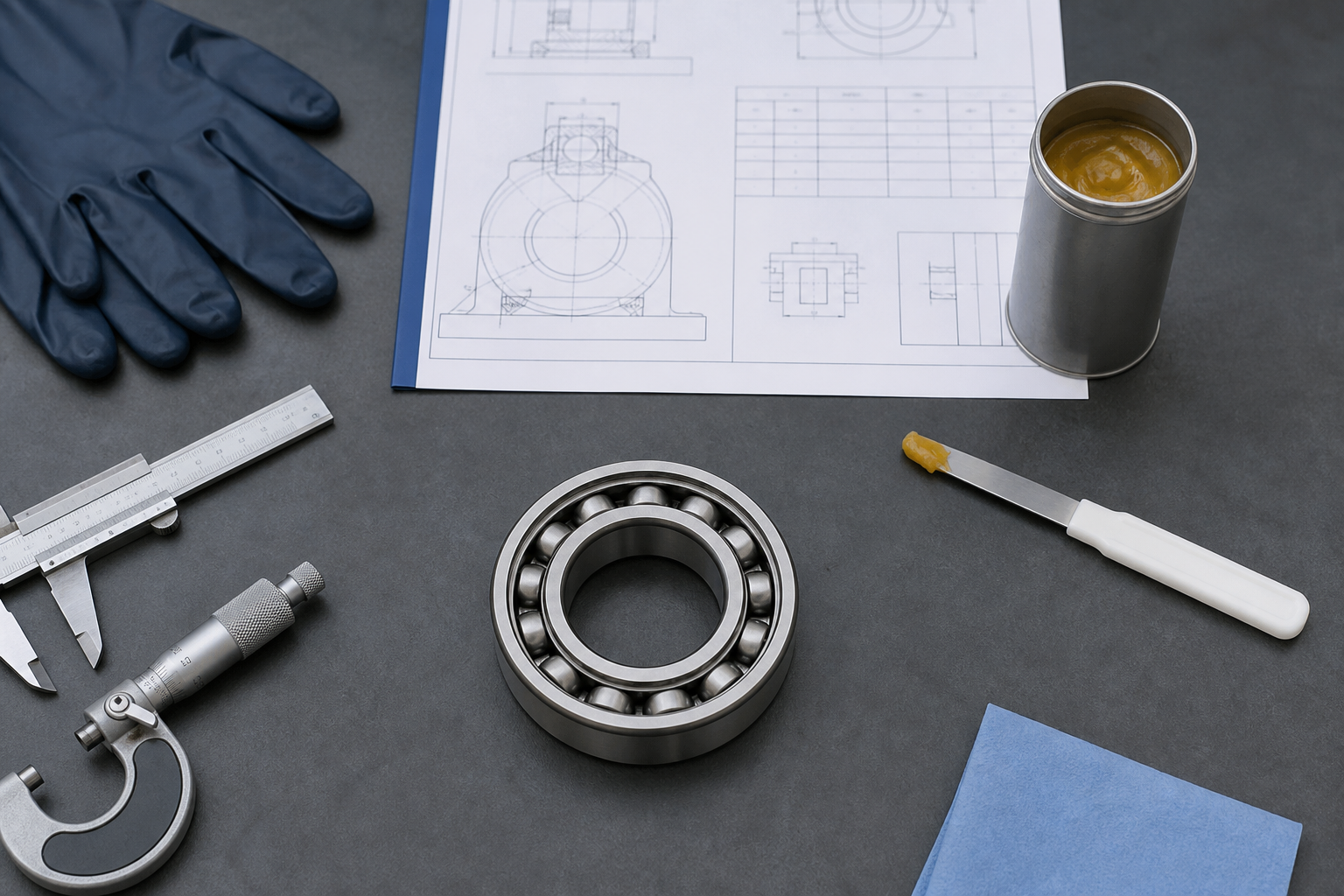
How to choose the best grease for bearings
There is no single product that is best in every bearing. Work through the following factors before choosing from Bearing Superstore’s lubricants and adhesives range.
1. Check the OEM specification first
The machinery, vehicle or bearing manufacturer should be the first reference. Look for:
- Recommended grease or approved equivalent
- Base-oil type and viscosity
- NLGI consistency grade
- Thickener type
- Operating-temperature range
- Required performance classifications
- Initial fill quantity and relubrication interval
These requirements take priority over general online advice. A change should only be made after confirming that the alternative meets the same needs and is compatible with any grease remaining in the system.
2. Consider bearing speed
Speed affects how quickly grease is worked and how much heat it produces. A grease that is too stiff or uses an unnecessarily viscous base oil can increase drag and operating temperature in a fast bearing. High-speed applications often favour a suitable lower-viscosity base oil and good mechanical stability, but the correct choice depends on bearing size and operating temperature as well as rotational speed.
Do not use “the thinnest grease that stays in place” as a specification on its own. Calculate or obtain the viscosity requirement from the manufacturer’s data. Schaeffler’s rolling-bearing lubrication guidance explains how speed, bearing geometry and load influence grease selection.
3. Match the load
Higher loads generally require a stronger lubricating film and may call for a higher base-oil viscosity or suitable anti-wear and extreme-pressure performance. Shock-loaded construction, agricultural and conveyor applications can need a different formulation from a lightly loaded electric motor.
More stiffness is not automatically better. NLGI grade describes a grease’s consistency, rather than its load-carrying ability. A grease can be NLGI 2 and still vary greatly in base-oil viscosity, additives and application suitability.
4. Allow for temperature
Check both normal running temperature and possible peaks. Grease life falls as temperature rises, while very low temperatures can reduce pumpability and raise starting torque. The quoted dropping point is not a safe continuous operating temperature; consult the product data sheet for the manufacturer’s recommended working range.
If a bearing has overheated, investigate the cause instead of simply switching to a “high-temperature” grease. Incorrect fit, misalignment, contamination, excessive preload or over-greasing may be responsible.
5. Account for water and contamination
Moisture, washdown, dust and chemicals can alter the choice. Calcium-sulphonate-complex greases are often considered for strong water resistance and corrosion protection, while other formulations may suit clean, dry conditions better. Food-production environments may also require an appropriately registered food-grade lubricant.
The seal arrangement is equally important. Lubricant alone cannot compensate for a damaged seal or a bearing unsuitable for the environment. Browse Bearing Superstore’s bearing range when a sealed, shielded or corrosion-resistant replacement is required.
Understanding the grease specifications
NLGI consistency grade
The NLGI number indicates how soft or firm a grease is. NLGI 2 is widely used in general bearing applications because it offers a practical balance between retention and pumpability. Lower numbers are softer; higher numbers are firmer. The correct grade still depends on the equipment design, temperature and delivery system.
Base-oil viscosity
Base-oil viscosity, commonly shown in mm²/s or cSt at 40°C, is not the same as NLGI grade. It has a major influence on film thickness. High speed generally points towards lower viscosity, while lower speed and greater load can require higher viscosity. Avoid prescribing a single viscosity from vehicle size or machine type alone.
Automotive GA, GB and GC categories
GA, GB and GC are wheel-bearing grease categories within ASTM D4950, not JASO classifications. GA covers limited mild-duty wheel-bearing service, GB covers mild-to-moderate duty, and GC covers more demanding high-temperature service. The NLGI confirms that a GC-certified grease is suitable for automotive wheel bearings under ASTM D4950.
For a serviceable automotive wheel bearing, follow the vehicle manufacturer’s requirement. Many modern hub units are sealed and lubricated for life; they should not be opened and repacked.
ISO 6743-9 classification
ISO 6743-9 provides the Family X classification system for greases used in equipment, machinery and vehicles. It is a separate classification framework from ASTM D4950. ISO codes help describe performance characteristics, but they do not replace the need to match the product to the application.
Best grease for bearings by application
General industrial bearings
The best grease for bearings in general industrial service is frequently an NLGI 2 lithium or lithium-complex product, provided it matches the application. Confirm the required base-oil viscosity, speed rating, load capability and temperature range. A product such as the FAG ARCA.MULTI3 bearing grease should only be selected after its current technical data has been checked against the application.
Automotive and trailer wheel bearings
When selecting the best grease for bearings in a vehicle or trailer, begin with the manufacturer’s wheel-bearing specification. Serviceable tapered roller bearings must be packed so grease reaches the spaces around the rollers. Do not assume every multipurpose grease is suitable for disc-brake temperatures or long motorway running.

Sealed hub assemblies are different: they are factory-filled units and are normally replaced if damaged. Opening a seal can introduce contamination and compromise its fit.
Electric motors and high-speed bearings
Electric-motor greases are selected for speed, temperature, noise, oxidation life and compatibility with the existing factory fill. Polyurea formulations are common in some motors, but the manufacturer’s recommendation remains decisive. Do not add a lithium grease merely because it is available in the workshop.
Wet, marine and washdown environments
Prioritise water washout resistance, corrosion protection and seal suitability. A grease that performs well under water exposure may still be unsuitable for a high-speed motor, so the full operating profile must be considered.
How much grease should you use?
Over-greasing is a frequent cause of rising temperature. Excess grease is churned by the rolling elements, increasing resistance and sometimes forcing lubricant past the seals. Under-greasing can be equally damaging.
For typical industrial arrangements, guidance sometimes places the bearing cavity around one-third to one-half full, but this is not a universal fill rule. Bearing type, housing free space, speed, orientation and sealing all matter. Use the OEM figure or a recognised calculation tool, such as Timken’s grease lubrication calculator, for initial fill and relubrication quantities.
When replenishing through a grease nipple:
- Isolate the machinery and follow the site’s lock-off procedure.
- Clean the fitting so contamination is not pumped into the housing.
- Confirm the grease and grease gun are correctly identified.
- Apply the measured quantity at the specified interval.
- Follow the equipment instructions for drain plugs, relief points and running conditions.
- Monitor temperature, noise and leakage after returning the equipment to service.
Do not make grease emerging through a bearing seal the universal signal to stop. Some housings have a designed purge route; others can be damaged by the pressure required to force grease past a seal.
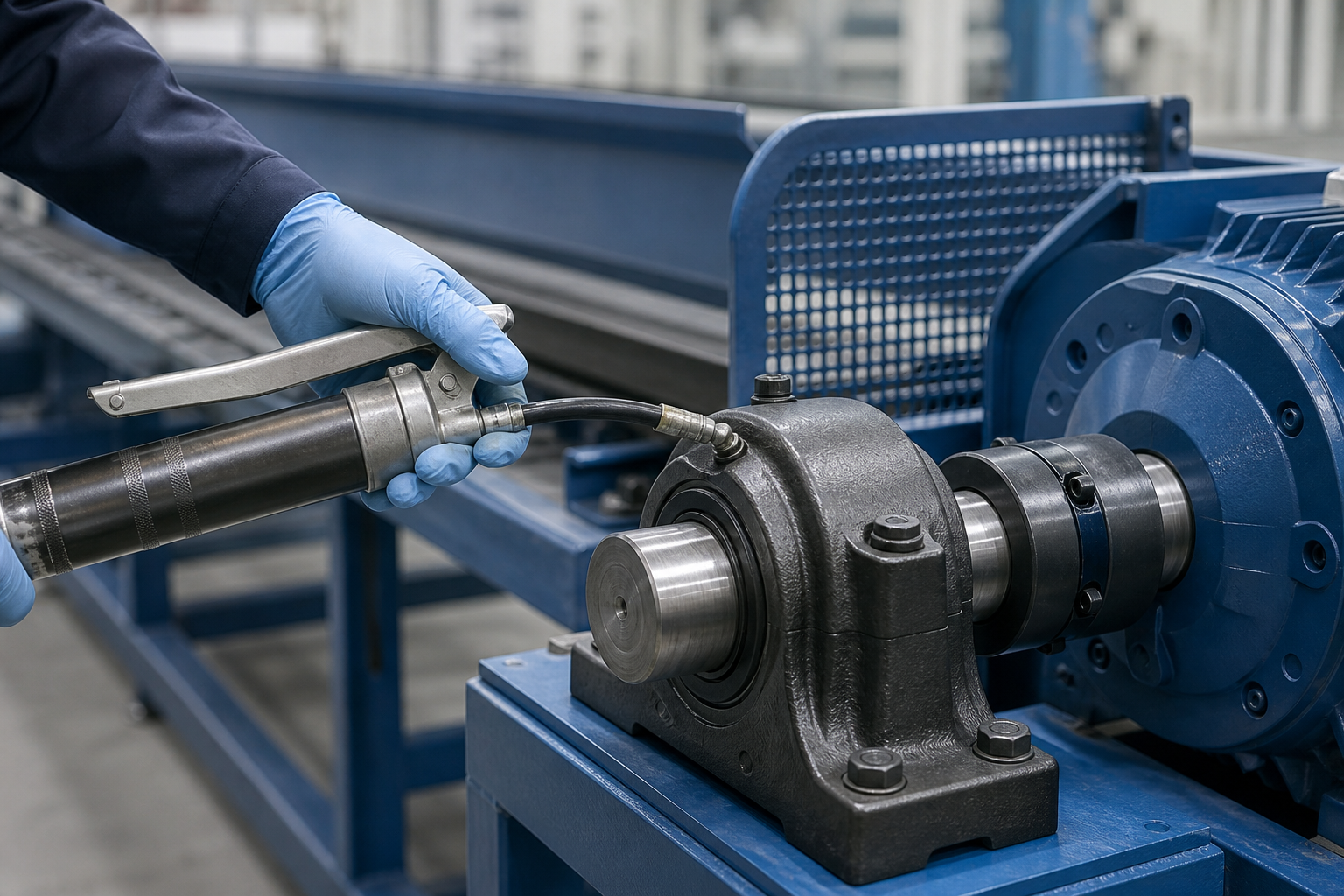
For maintainable industrial assemblies, Bearing Superstore supplies housed bearing units alongside open and sealed bearing options.
Can different bearing greases be mixed?
Do not assume that greases are compatible because they share a colour, NLGI grade or broad thickener description. Mixing can soften or harden the grease, release oil, reduce temperature capability or impair additives. Even products based on apparently similar thickeners may not be interchangeable.
Polyurea and lithium-based greases are not universally incompatible or universally compatible; the result depends on the formulations. Check both manufacturers’ compatibility information. For a critical application, a controlled laboratory compatibility test or complete clean-out may be necessary. A workshop hot-plate “drop test” is not a reliable or safe substitute for technical data.
If the existing product cannot be identified, contact the equipment manufacturer, grease supplier or a lubrication specialist before topping up.
Should a bearing be cleaned or replaced?
Small sealed or shielded bearings lubricated for life should not be washed. If the seal is damaged, contamination has entered, or the bearing feels rough or noisy, replacement is generally the safer choice. Bearing Superstore stocks both open bearings suitable for accessible lubrication and double-sealed bearings designed to retain their factory lubricant.
Open, removable bearings may be cleaned for inspection when the equipment manufacturer allows it. Record the condition of the old lubricant first. Use the approved cleaning method and suitable personal protective equipment, keep dirt away from the raceways, and relubricate promptly. Never spin a dry bearing with compressed air.
Brake cleaner should not be treated as a universal bearing-cleaning method. Formulations vary, and solvents may affect seals, coatings or plastics. NSK’s bearing inspection guidance describes controlled preliminary cleaning and finishing rinsing of dismantled open bearings using light oil or kerosene.
Replace a bearing when inspection reveals faults such as:
- Cracks, flaking or severe raceway damage
- Significant scoring, indentation or corrosion
- A badly worn or damaged cage
- Obvious heat discolouration
- Damaged seals or shields
- Roughness, excessive play, abnormal noise or vibration confirmed during diagnosis

How often should bearings be greased?
There is no dependable “every six months” rule. Relubrication frequency depends on speed, load, temperature, bearing type and size, operating hours, contamination, moisture and sealing efficiency. Higher temperature, greater contamination or ineffective sealing often shortens the interval.
Build the maintenance plan from the OEM recommendation, then refine it using service history and condition monitoring. Record the grease used, measured quantity, date, machine hours and observations. Trending bearing temperature, vibration and grease condition is more useful than repeatedly adding grease without evidence.
Bearing grease selection checklist
To select the best grease for bearings without guesswork, confirm:
- The exact bearing and equipment specification
- Operating speed, load and temperature
- Exposure to water, dust, chemicals or washdown
- Required base-oil viscosity and NLGI grade
- Thickener and compatibility with the existing grease
- Required standards or approvals
- Initial fill and relubrication quantity
- Relubrication interval and application method
- Seal condition and whether the bearing is serviceable
- Current technical and safety data sheets
Choose by specification, not guesswork
The best grease for bearings is not necessarily the thickest, most expensive or most heavily marketed product. It is the lubricant whose base oil, consistency, thickener, additives and approvals match the bearing’s real operating conditions.
Start with the manufacturer’s data, keep grease clean, use a measured quantity and avoid mixing products without verified compatibility. If the bearing is sealed, damaged or heat-discoloured, replacement may be more reliable than attempting to clean and repack it.
Explore Bearing Superstore’s range of bearings and lubricants and adhesives, or contact the team with the bearing reference and operating details for help matching products to your application.
Technical note: This guide provides general selection and maintenance information. Always follow the machinery, vehicle and bearing manufacturer’s instructions and applicable site safety procedures.