What Are Linear Bearings and Why They Matter
A linear bearing is a component designed to enable smooth, low-friction movement along a straight line, rather than around a fixed point. So what are linear bearings, exactly? In simple terms, they are the mechanical equivalent of a train on a track: a moving element (often called a carriage or bushing) travels along a rail or shaft, supported by rolling or sliding elements that carry the load while minimising resistance.
This is the key distinction between linear motion bearings and traditional rotary bearings. Rotary bearings, such as the deep groove ball bearings found in motors and gearboxes, are built to support rotation around an axis. Linear bearings, by contrast, are engineered to convert or support motion in a single, straight direction. Many linear systems still rely on rolling elements, such as balls or rollers, but their geometry and raceways are designed for translation rather than rotation.
The linear bearing definition matters because these components sit at the heart of countless machines that need precise, repeatable straight-line movement. Their main advantages include exceptional positioning precision, significantly reduced friction compared with plain sliding contact, high load capacity relative to their size, and long service life when properly maintained and lubricated.
Industries that depend heavily on linear motion systems include machine tool manufacturing, robotics and automation, medical equipment, aerospace, packaging, and semiconductor production. Anywhere a machine needs to move a tool, sensor, or workpiece along a defined path with high repeatability, you’ll typically find a linear bearing doing the work.
The technology has come a long way. Early linear motion relied on simple dovetail slides and plain bushings, which suffered from friction and wear. The development of recirculating ball technology in the mid-20th century was a turning point, allowing bearings to travel indefinitely along a shaft without running out of rolling elements. Today’s linear guide systems benefit from advanced steel treatments, precision grinding, and increasingly, integrated sensors, making them faster, more accurate, and more durable than ever.
How Linear Bearings Work: The Mechanics Explained
Understanding how linear bearings work starts with the basic operating principle: a carriage or bushing rides along a hardened shaft or rail, and rolling or sliding elements positioned between the two reduce friction, allowing smooth, controlled movement.
Step-by-step operation
- A hardened, precision-ground shaft or rail is fixed in place along the intended path of travel.
- A bearing housing, containing balls, rollers, or a low-friction bushing material, is fitted around or onto the rail.
- As an external force (from a motor, actuator, or manual input) pushes the carriage, the rolling or sliding elements allow it to move with minimal resistance.
- The load is transferred through the contact points between the rolling elements and the raceway, into the mounting structure.

The role of balls and rollers
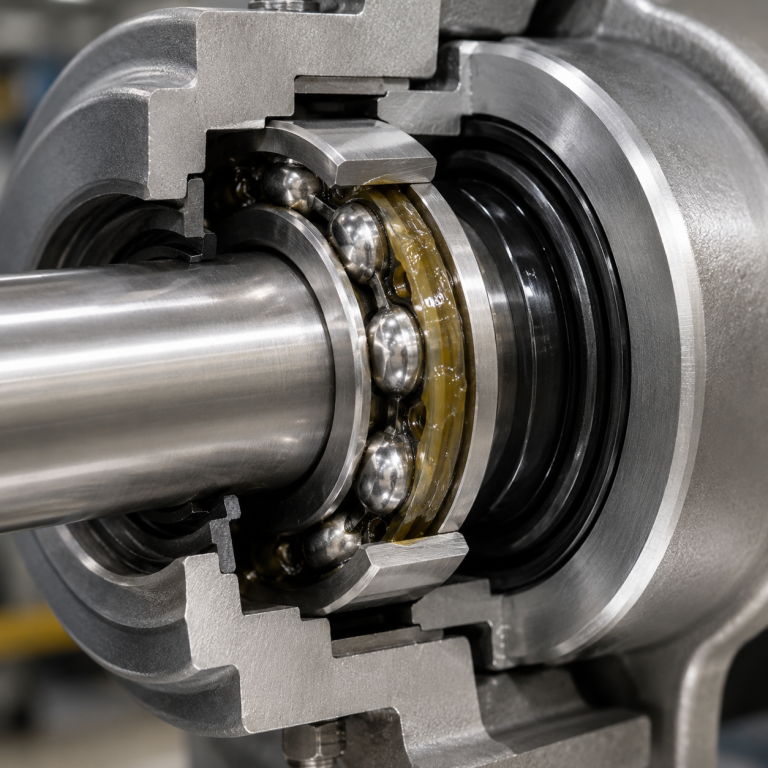
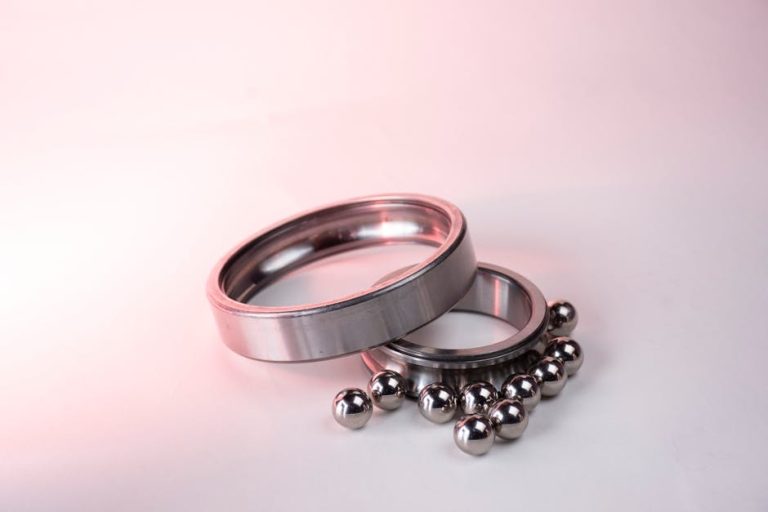
In most linear bearing mechanics, balls or rollers are the key to reducing friction. Rather than the carriage sliding directly against the shaft (which generates high friction and rapid wear), the load is carried on small, hardened rolling elements. Ball elements offer a good balance of speed, smoothness, and cost, making them popular for general-purpose applications. Rollers offer greater surface contact area, so they’re typically favoured where higher load capacity is the priority.
Recirculating ball bearings
One of the most important innovations in this field is the recirculating ball bearing system. Instead of a fixed number of balls confined to a short raceway, a recirculating design channels the balls in a continuous loop: they carry the load along the main raceway, then return via an internal return path to the start, ready to bear load again. This is what allows a linear bearing carriage to travel indefinitely along a shaft of any practical length, rather than being limited to a short stroke.
Load distribution and contact geometry
The way load is distributed depends on contact point geometry. In ball-type bearings, load is transmitted through small, point-like contact areas, which is efficient but concentrates stress. Roller-type bearings use line contact, spreading the load over a larger area and improving capacity for heavier applications, though often at a slight cost to top speed.
Lubrication and friction coefficients
Even with rolling elements, linear bearings require lubrication to reduce metal-to-metal contact, dissipate heat, and prevent corrosion. Grease is the most common choice for general use, while oil is often specified for high-speed or high-temperature applications. Typical friction coefficients for a well-lubricated recirculating ball bearing are extremely low, often a fraction of that seen in plain sliding contact, which is precisely why these systems are so efficient.
Precision grading and tolerances
Linear bearings and guide rails are manufactured to specific precision grades (commonly labelled normal, high, precision, and ultra-precision, depending on the manufacturer). These grades define permissible tolerances for parallelism, straightness, and running accuracy. Selecting the correct precision grade is essential: over-specifying adds unnecessary cost, while under-specifying can compromise accuracy in demanding applications.
Main Types of Linear Bearings and Their Characteristics
There are several distinct types of linear bearings, each suited to different combinations of load, speed, precision, and environment.
Ball bushing linear bearings
Ball bushing bearings consist of a cylindrical housing containing recirculating ball elements that ride along a round shaft. They offer smooth, low-friction motion and are widely used in general automation, printing equipment, and light-to-medium load applications where the round-shaft format simplifies design and installation.

Linear roller bearings
Where heavier loads are involved, linear roller bearings are often the better choice. Using cylindrical or needle rollers instead of balls, they provide greater contact area and higher load capacity, making them well suited to heavy machine tools, presses, and structural positioning systems.
Plain linear bearings and self-lubricating options
Plain linear bearings, sometimes called bushings, rely on a low-friction sliding surface rather than rolling elements. Self-lubricating variants, often incorporating PTFE or bronze-impregnated liners, are popular in applications where routine lubrication is impractical, such as food processing or hard-to-access machinery. They tend to be quieter and more tolerant of contamination, though generally at lower speeds and precision than rolling-element designs.
Magnetic linear bearings
For ultra-clean environments such as semiconductor fabrication and vacuum systems, magnetic linear bearings use magnetic levitation to eliminate physical contact entirely. This removes friction, wear, and particulate generation altogether, at a significantly higher cost and typically lower load capacity than mechanical alternatives.
Linear ball guides and rail systems
Linear ball guides (also called profile rail guides) pair a precision-ground rail with a carriage block containing recirculating balls or rollers. They are available in a wide range of sizes, from miniature guides for instrumentation to heavy-duty rails for industrial gantries, and are prized for their high rigidity and ability to carry loads from multiple directions simultaneously.

Comparison of linear bearing types
| Type | Load Capacity | Precision | Speed | Relative Cost |
|---|---|---|---|---|
| Ball bushing | Low–Medium | High | High | Low–Medium |
| Linear roller | High | Medium–High | Medium | Medium–High |
| Plain/self-lubricating | Low–Medium | Medium | Low–Medium | Low |
| Magnetic | Low–Medium | Very High | High | Very High |
| Linear ball guide/rail | Medium–High | Very High | High | Medium–High |
Selection criteria
Choosing between these types of linear bearings comes down to matching characteristics to the application: how much load must be supported, what speed and acceleration are required, how clean or contaminated the environment is, what precision the task demands, and what the budget allows. A CNC machining centre and a simple pneumatic slide, for example, will call for very different solutions despite both technically being “linear motion” applications.
Common Applications and Industries Using Linear Bearings
Linear bearing applications span almost every sector of modern manufacturing and technology.
- CNC machines and automated manufacturing equipment rely on linear guide rails for the X, Y, and Z axes, where repeatable positioning accuracy directly affects part quality.
- 3D printers and additive manufacturing systems commonly use linear rails or rods to move the print head or build platform with the consistency needed for fine layer resolution.
- Medical equipment, including CT scanners and surgical robots, depends on ultra-smooth, low-vibration linear motion to position imaging equipment or surgical instruments with sub-millimetre accuracy.
- Semiconductor manufacturing and wafer handling systems often specify magnetic or air-bearing linear systems, where even microscopic particulate contamination could ruin a wafer.
- Packaging and conveyor systems in the food and beverage industry use linear bearings, frequently in corrosion-resistant or washdown-rated housings, to drive pick-and-place mechanisms and filling equipment at high speed.
- Aerospace applications use precision linear positioning systems in everything from satellite component assembly to flight simulator motion platforms, where reliability under extreme conditions is critical.
- Automotive assembly line automation uses linear bearings extensively in robotic welding cells, parts transfer systems, and quality inspection stations, where 24/7 duty cycles demand long service life.
As a specific example, a typical CNC router might specify linear guide rails rated for several hundred kilograms of dynamic load, operating at traverse speeds of several metres per minute, while maintaining positioning repeatability within a few microns. A food-grade conveyor pusher, by contrast, might prioritise a washdown-rated, corrosion-resistant bearing over ultimate load capacity, since hygiene and reliability under wet conditions matter more than raw precision.
How to Select the Right Linear Bearing for Your Project
Load calculation
Start by calculating both dynamic load (the force experienced while the bearing is moving) and static load (the force experienced while stationary, including any peak or shock loads). Manufacturers publish rated dynamic and static load values, and it’s good practice to apply a safety factor rather than designing right up to the limit.
Speed and acceleration requirements
Higher speeds and rapid acceleration increase heat generation and can affect lubrication performance, so applications with fast cycle times need bearings and lubricants rated accordingly.
Environmental factors
Consider temperature range, exposure to dust or debris, moisture, and any washdown or chemical exposure. Contamination is one of the most common causes of premature bearing failure, so sealed or self-lubricating designs are worth considering in harsher environments.
Precision requirements
Match the accuracy class to the task. A packaging line pusher rarely needs the same precision grade as a semiconductor positioning stage, and paying for unnecessary precision adds cost without practical benefit.
Space constraints and mounting configuration
Available envelope, mounting orientation, and whether the bearing must resist loads from multiple directions (moment loads) will influence whether a round-shaft, profile rail, or compact linear guide system is the right shape for the job.
Budget and total cost of ownership
The cheapest bearing upfront isn’t always the most economical choice. Factor in expected service life, maintenance requirements, and the cost of unplanned downtime when comparing options.
A simple decision approach
- Define load (static and dynamic) and required precision.
- Identify environmental exposure (clean, dusty, wet, high-temperature).
- Shortlist bearing types that meet load and environment requirements.
- Compare speed and duty cycle capability across shortlisted options.
- Weigh total cost of ownership, not just unit price.
Common mistakes to avoid
Common errors include under-sizing bearings based on static load alone (ignoring dynamic and shock loads), overlooking contamination risks in the operating environment, specifying excessive precision that inflates cost unnecessarily, and failing to account for mounting rigidity, which can undermine even a correctly specified bearing.
Installation, Maintenance, and Troubleshooting Tips
Installation and alignment
Mounting surfaces should be clean, flat, and free from burrs before fitting. Rails and shafts must be properly aligned and adequately supported along their length, as poor alignment is a leading cause of premature wear, noise, and binding. Torque fixing bolts to the manufacturer’s specification, and check for smooth movement across the full stroke before putting the equipment into service.
Lubrication schedules
Follow the manufacturer’s recommended lubrication interval and lubricant type, whether grease or oil. Under-lubrication accelerates wear, while over-lubrication can attract contamination and increase running resistance. High-duty-cycle applications generally require more frequent relubrication than intermittent-use equipment.
Cleaning and contamination prevention
Wipers and seals should be inspected regularly and kept free of debris build-up. In dusty or abrasive environments, additional bellows or covers can significantly extend service life by keeping contaminants away from the raceway.
Signs of wear and when to replace
Watch for increased play or looseness in the carriage, inconsistent or jerky movement, visible pitting or discolouration on the raceway, and a noticeable rise in operating temperature. Any of these signs suggest it’s time for closer inspection or replacement.
Common problems
Noise often points to contamination, inadequate lubrication, or misalignment. Binding can result from misalignment, debris ingress, or an over-tightened mounting. Premature failure is frequently traced back to incorrect bearing selection, poor installation, or inadequate lubrication.
Troubleshooting checklist
- Check alignment and mounting torque first, as these are the most common root causes.
- Inspect lubrication: is the correct type and quantity present?
- Look for visible contamination or damage to seals and wipers.
- Review load conditions against the bearing’s rated capacity.
- Confirm operating temperature and speed are within specification.
Expected service life
Service life varies considerably depending on load, speed, contamination, and lubrication practices, but well-maintained linear bearings in appropriate applications commonly achieve years of reliable operation before requiring replacement.
Preventive maintenance checklist
- Inspect seals and wipers on a regular schedule.
- Relubricate according to the manufacturer’s recommended interval.
- Check for unusual noise or resistance during routine operation.
- Verify mounting bolts remain correctly torqued.
- Keep a maintenance log to track intervals and identify recurring issues early.
Future Trends in Linear Bearing Technology
Smart bearings with embedded sensors are an increasingly significant development, capable of monitoring vibration, temperature, and load in real time, and feeding that data into IoT-connected monitoring systems.
Advanced materials are extending the boundaries of where linear bearings can operate, with coatings and alloys now designed to withstand extreme temperatures, corrosive environments, and vacuum conditions.
Miniaturisation is opening up new applications in micro-precision fields such as medical devices, optical instruments, and compact robotics, where space is at an absolute premium.
Sustainability is also becoming a bigger consideration, with manufacturers exploring recyclable materials and longer-life designs to reduce the environmental impact of replacement components.
Perhaps most significantly, the integration of linear bearings with Industry 4.0 and predictive maintenance systems means downtime can increasingly be anticipated and prevented, rather than reacted to after a failure occurs. As sensor costs fall and connectivity becomes standard, expect condition-monitoring capability to move from a premium feature to an everyday expectation across linear motion systems.
Looking for the right linear bearing for your application? Browse our range of linear bearings or get in touch with our team for expert advice on selecting the correct type for your project.